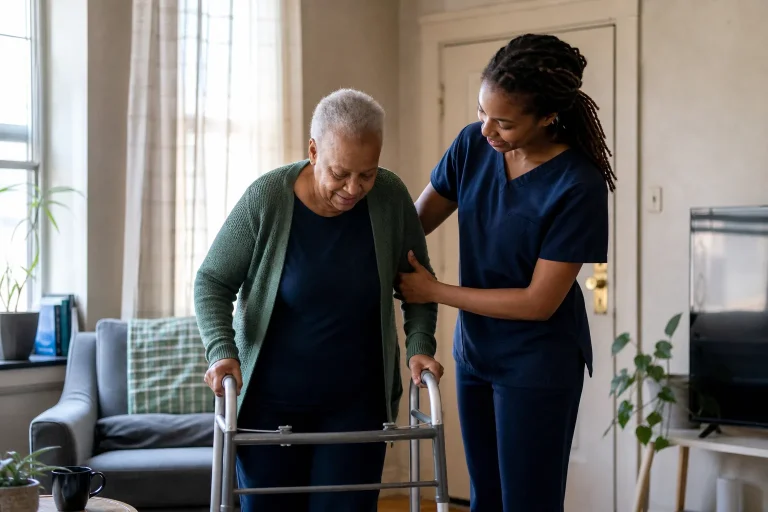
Open a search browser late at night and the ads arrive quickly: “Become a certified caregiver in weeks.” “Guaranteed jobs.” “Visa support included.” The photos are warm—folded hands, soft light, a smiling older adult. The fine print, if it exists, is colder.
Online caregiver training can be excellent. It can also be expensive theatre. The difference is rarely the presence of a learning management system or a downloadable certificate. The difference is honesty: Does the program teach skills you can practise within a real role, or does it sell a feeling of arrival?
This guide is for people comparing online caregiver and healthcare support courses—whether you are new to care work, already employed and upskilling, supporting a family member, or exploring options across Canada, the United States, the United Kingdom, or Nigeria. Use it as a buyer’s framework before you enrol.
Start with purpose, not with a glossy syllabus
Before comparing platforms, write one sentence: “I need this course so that ___.” Examples of honest purposes:
- I want stronger infection prevention and documentation habits for my current home care job.
- I am exploring whether caregiving is a fit before applying to a college program.
- I support my parent at home and need practical dementia communication skills.
- I am an internationally educated professional building a Canadian skills track while pursuing registration separately.
If your sentence includes “so that I get a visa” or “so that I become licensed automatically,” stop. Those outcomes are not sold ethically as course benefits. See healthcare training for internationally educated professionals in Canada for dual-track planning, and caregiver training in Canada for local career context.

Eight questions that separate useful courses from empty certificates
1. Are learning outcomes concrete?
Look for outcomes you could demonstrate: “practise hand hygiene sequences,” “document observations in factual language,” “use one-idea communication strategies with a person living with dementia.” Vague outcomes—“become a compassionate caregiver”—are marketing, not curriculum design.
2. Is the scope of practice stated?
Care roles differ by country and employer. A responsible course says what support workers typically may and may not do, and reminds you to follow local policy. Medication topics should stress awareness and limits—see Figora’s Medication Awareness framing and medication safety guidance.
3. How is learning assessed?
Clicking “next” until a PDF appears is not assessment. Prefer quizzes that check understanding, scenario judgments, reflection prompts, or practical checklists you can take into supervised practice. Assessment does not need to be punitive; it needs to be real.
4. Who is the intended learner?
Family caregivers, new support workers, and clinicians refreshing overlapping skills have different needs. A course that claims to be for everyone forever is often for no one in particular.
5. How current is the guidance?
Infection prevention, digital tools, and privacy expectations evolve. Providers should review content against public guidance from bodies such as WHO, CDC, NHS, PHAC, and Canada.ca—without inventing study citations. Ask when materials were last updated.
6. What support exists when you are stuck?
Even asynchronous courses benefit from clear FAQs, technical help, and pointers to escalate clinical questions to appropriate professionals. Training should never encourage you to diagnose or practise beyond authorization.
7. How is the certificate described?
Ethical language: “Certificate of completion for professional development.” Problematic language: “Licence,” “guaranteed employment,” “immigration pathway,” “internationally recognized authorization to practise.”
8. Can you map the course to a career pathway?
Useful learning stacks. Foundations, then infection control, then dementia, then documentation—linked to a career pathway and recorded in a Skills Passport. Random certificates with no narrative help less than a coherent plan; see building a skills development plan.

What strong caregiver curricula usually include
While every program differs, high-utility online caregiver education often covers clusters that public health and workforce educators return to repeatedly:
- Personal support foundations — dignity in daily living support, privacy, encouragement of independence. Course example: Caregiver & Personal Support Foundations.
- Infection prevention and control — hand hygiene, PPE when required, environmental awareness. Course example: Infection Prevention & Control; explainer: what IPC means.
- Dementia-aware practice — communication, observation, reduced confrontation. Course example: Dementia Care Training; article: dementia care skills.
- Documentation — factual notes, escalation language. Course example: Healthcare Documentation.
- Mental health support awareness — recognizing distress, supporting without overstepping. Course example: Mental Health Support.
- Digital and administrative literacy — increasingly relevant in modern care teams: Digital Health & Telemedicine, Healthcare Administration, AI in Healthcare.
If you are comparing programs for home and community work specifically, read building a career in home and community care so curriculum choices match the realities of mobile, relationship-based roles.
Red flags that should end the purchase
- Guaranteed jobs after completion.
- Implied or explicit licences issued by the course provider for regulated practice.
- Visa, work permit, or permanent residence promises tied to enrolment.
- Pressure timers that shame you for reading the syllabus carefully.
- “Valid in all countries” claims that ignore local regulation.
- No human-readable outline before payment.
- Testimonials that sound identical or cannot be contextualized.
- Instructions to practise invasive or restricted acts without reference to authorization and supervision.
Public guidance from WHO, CDC, NHS, PHAC, and Canada.ca can help you sanity-check clinical themes. It cannot rescue a provider that sells immigration theatre.

How to transfer online learning into real shifts
Enrolment is the easy day. Transfer is the work:
- Pick one habit from the course for your next five shifts.
- Tell a supervisor what you are practising if workplace culture allows.
- Keep a three-line reflection after difficult visits.
- Revisit modules when a real case exposes a gap.
- Update your Skills Passport so learning stays visible.
Pair this with Healthcare Career Readiness if you are organizing applications, interviews, and professional storytelling. For long-term growth from support roles toward leadership responsibilities, see healthcare career development: from entry-level support work to leadership and keeping healthcare skills current.
A note for family caregivers
If you are not seeking employment, online training can still reduce fear and improve daily routines. Prioritize communication, safety, infection prevention, and knowing when to seek clinical help. You still should not treat a course as medical advice. Use public resources from reputable health agencies, and keep your family member’s clinicians in the loop for health changes.
Compare providers with a simple scorecard
If you are deciding between two or three programs, score each from 1 to 5 on: clarity of outcomes, honesty about limits, assessment quality, currency of content, learner support, and ethical marketing. Ignore flashy video production if the syllabus is vague. Prefer a plain course that teaches hand hygiene and escalation judgment over a cinematic course that promises a new life in another country.
Also compare practical access details: How long do you retain materials after completion? Is mobile learning usable during commute gaps? Are scenarios set in home care, facilities, or both? Can you download checklists for workplace use? These logistics determine whether learning transfers. Pair your chosen course with a practice plan and, where useful, stack related Figora modules such as Infection Prevention & Control and Dementia Care Training rather than buying unrelated bundles.
Finally, ask one uncomfortable question: “If this certificate disappeared tomorrow, would I still retain habits that make care safer?” If the honest answer is no, the course is decoration. If the answer is yes, you are buying education rather than a prop for applications.
FAQ
Is a cheaper course always lower quality?
Not always. Judge outcomes, assessment, scope honesty, and update practices. Some expensive courses sell branding; some affordable courses teach clearly. Price is data, not a verdict.
Can online training alone qualify me to work as a caregiver?
Sometimes employers hire based on their own criteria and then train you on the job; sometimes they require specific local credentials. Online learning can strengthen readiness but does not automatically qualify you everywhere. Confirm local and employer requirements.
What if a course promises “international certification”?
Ask what that phrase means in writing. A completion certificate from a provider is not the same as recognition by a government regulator. If the answer is vague, walk away.
How many courses should I take at once?
Fewer than you think. Complete one cluster, practise it, then add the next. Stacking five unfinished courses helps less than finishing two that change your habits.
Does Figora guarantee employment after coursework?
No. Figora does not guarantee jobs, licensure, immigration status, employment authorization, or visa approval. Courses support skills development and career readiness education only.
Sources & further guidance
- WHO — public guidance relevant to caregiving, infection prevention, dementia, and health workforce education themes.
- CDC — accessible resources on caregiving, hygiene, and community health protection.
- Public Health Agency of Canada / Canada.ca — national public health information useful for Canadian learners comparing course claims to official guidance.
- NHS — practical public pages on supporting people at home and recognizing when to seek clinical advice.
- Local regulators and employers — definitive sources for whether a credential is required for a specific paid role.
Educational article from Figora Insights. This content supports learning decisions and professional reflection. It is not a substitute for clinical advice, employer protocols, or immigration advice. Figora does not grant licensure, immigration status, employment authorization, or visa approval.